


Please Leave Us A Message
Privacy statement: Your privacy is very important to Us. Our company promises not to disclose your personal information to any external company with out your explicit permission.



A shaft hub connection is the critical interface where power transmission components join rotating shafts to hubs, gears, or pulleys. In heavy industrial applications like wind turbines and gearbox systems, these connections must withstand immense torque, radial loads, and cyclic stress without slipping or failing.
For procurement managers sourcing high-performance shaft hub connections, the choice between traditional keyways and modern friction-locking devices (like shrink discs) directly impacts machine uptime and maintenance costs. Shrink disc solutions provide uniform clamping force around the entire circumference, eliminating stress concentrations typical of keyed joints and ensuring zero backlash in precision drivetrains.
Jiangyin Liaoyuan New Energy Co., Ltd. manufactures these essential components using integrated forging and precision machining capabilities, ensuring that every industrial shaft hub connection meets the rigorous demands of global OEM supply chains.
From open-die forging to CNC machining, we control every stage of production to deliver reliable shaft hub connections.
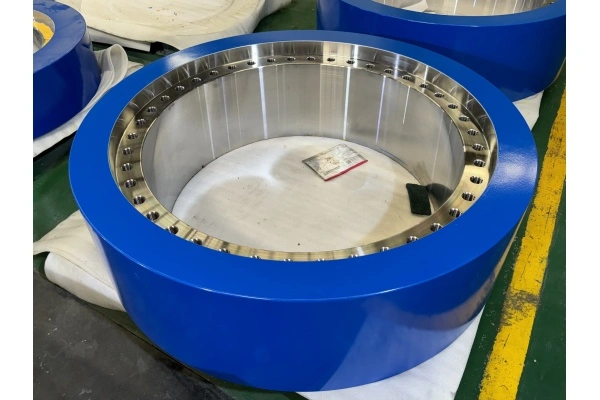
Our manufacturing facility in Jiangsu Province spans 60,000 m² and supports an annual forging capacity of 120,000 tons. This scale allows us to handle large-volume orders for heavy-duty shaft hub connections while maintaining strict quality control at every stage.
Open-die forging up to 10 tons and ring rolling up to 5 meters diameter ensure dense grain structure for high-strength hubs.
Advanced CNC equipment delivers tight tolerances for interference fits, critical for reliable locking device performance.
Quality Assurance: Our inspection team utilizes CMM measurement and advanced ultrasonic testing to verify material integrity. Every batch of custom forged shaft hub connections undergoes rigorous non-destructive testing to prevent field failures.
High-torque applications like wind turbine main shafts require shrink discs with high friction coefficients. Evaluate your peak load scenarios to select the appropriate clamping force rating.
Shrink discs offer compact designs compared to multi-spline or keyed connections. When axial space is limited, our compact locking devices provide maximum power transmission in minimal footprint.
Consider disassembly frequency. Friction locks allow easy removal without heating, reducing downtime during maintenance cycles for industrial gearbox components.
Choosing the right steel grade for your shaft hub connections depends on operating temperature, corrosion exposure, and fatigue life requirements. Liaoyuan supplies components in standard grades (42CrMo, 40CrNiMo) or custom alloys per your specifications.
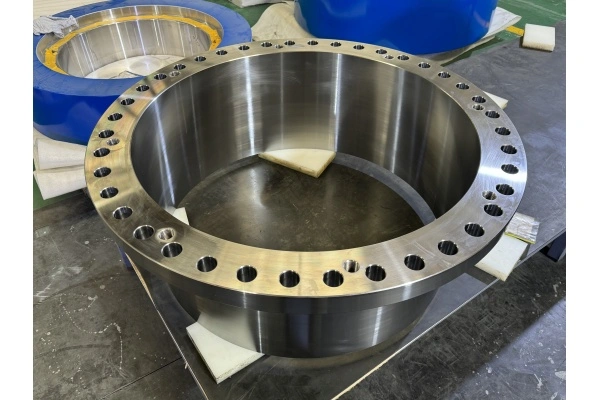
Use this checklist to evaluate potential suppliers and ensure you select the best partner for your shaft hub connection sourcing needs.
With 60,000 m² facility, 120,000-ton annual capacity, 380 employees, and integrated forging-to-machining process, we satisfy all technical and supply chain requirements for reliable shaft hub connections.
Sourcing industrial components comes with risks. Here are common issues buyers face and how to avoid them.
Improper fit tolerance or insufficient clamping force causes hub slippage. Solution: Specify shrink discs with verified friction coefficients and demand torque test reports from your supplier.
Variations in forging density or machining tolerances between batches lead to assembly failures. Solution: Partner with manufacturers who have integrated processes and in-house QC labs, not trading companies.
Subcontracting multiple processes (forging, heat treat, machining) creates bottlenecks. Solution: Choose a supplier with end-to-end control over the manufacturing chain to reduce handoff delays.
Standard carbon steel hubs degrade quickly in marine or chemical environments. Solution: Specify stainless steel or protective coatings early in the design phase to prevent premature failure.
When evaluating potential partners for shaft hub connection manufacturing, consider these key criteria based on industry best practices.
Prioritize suppliers who control forging, heat treatment, and machining under one roof. This integration reduces lead times and ensures material traceability.
Verify ISO 9001 certification and ask for specific NDT (non-destructive testing) capabilities. Ultrasonic testing is essential for safety-critical components.
Choose suppliers with proven track records serving international OEMs. Familiarity with export logistics and compliance standards simplifies procurement.
Founded in 1997, Liaoyuan combines decades of expertise with modern capabilities. Our 380-strong team, including dedicated quality specialists, ensures every locking device and coupling hub meets exact specifications. Located 140 km from Shanghai Port, we offer efficient logistics for global shipments.
Get answers to common questions about sourcing, specification, and installation of industrial shaft hub connections.
Shrink discs use radial pressure to create friction-based locking, providing uniform clamping force around the entire shaft circumference. Unlike keyed connections, they eliminate stress concentrations, offer zero backlash, and allow easier disassembly without heating.
Yes. We produce custom forged rings up to 5 meters in diameter and machined components to your exact CAD specifications. Our flexible manufacturing lines accommodate both prototype runs and high-volume production.
Standard materials include 42CrMo and 40CrNiMo alloy steels. For corrosive environments, we can supply stainless steel variants. All materials come with mill certificates and undergo ultrasonic testing.
Standard lead times range from 4-8 weeks depending on size and complexity. Rush orders are accommodated when possible. Our integrated process (forging through machining) minimizes external dependencies.
Privacy statement: Your privacy is very important to Us. Our company promises not to disclose your personal information to any external company with out your explicit permission.
Fill in more information so that we can get in touch with you faster
Privacy statement: Your privacy is very important to Us. Our company promises not to disclose your personal information to any external company with out your explicit permission.